
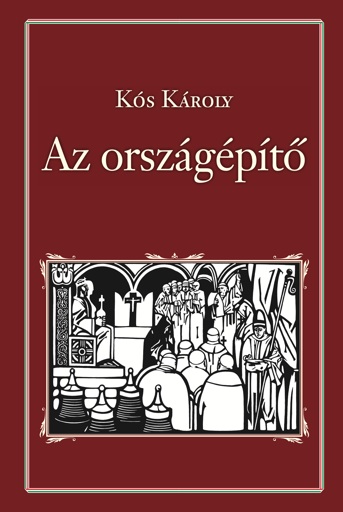
Károly Kós - The country builder
Historians research the past, writers dream about the past.
A thousand years ago, perhaps on Christmas of the thousandth year, perhaps on January 1, 1001, Géza's son István, the founder and first king of our country, was crowned king of Hungary. When he was born, he was called Vajk, he received the name István at baptism, the Christian ruler who built the country was canonized after his death in 1083.
We Hungarians have lived in the country of St. Stephen for a thousand years.
Latin legends, diplomas, copies of founding documents, the first and second law books of Saint István, Intelmei written for his son, Prince Imre, who condensed his moral and political creed, the notes of contemporaries and former historians: authentic sources that can be researched, interpreted and written for historians. After their thorough study, smart and accurate historical works were created, as comprehensive as possible mappings of King István's state-founding and country-building deeds.
As possible... - since the written sources are silent about the intricate secrets of everyday life, everyday events, people's worries and troubles, and the storms of their souls.
How did Bishop Gellért reason when he felt that he had already taught Prince Imre what he knew, and now - after completing his task - he asked István to let him retire to the Bakony, a Benedictine hermitage, to meditate and live a lonely spiritual life?
What emotions boiled over in Voivode Gyula of Erdőelv when he was given a royal command: the land is his property, but the land's treasure - salt, silver, gold - belongs to the king, the lord of the country, and István expects him to hand it over to him?
What did Princess Sarolt, King István's mother, say, when the king's son at the head of his army occupied the territories beyond the Tisza and forced the voivode to surrender, and Sarolt, who had taken refuge with him?
How did István argue with the rebel Vazul? How did he ride the horse? What did he feel, what did he think when he looked into the cold blue eyes of his spouse Gizella?
Károly Kós read a lot about King István, his time and his life. He learned "history"; but he wanted to write the story: he dreamed of the past.
"The soldier's house is also desolate, a bachelor who is also at home in the castle, sleeps in the porch or in the shadow of the eaves... In the shadow of an eaves, a thin tree stretches out..."
Did a porch exist a thousand years ago? Was there a gutter on the edge of the roof, and if so, was it called an eaves?
"The city is moving, children are screaming on the street." Our word street is of Slavic origin, we already have a written record of the word's existence from 1337, but who knows for sure what the Hungarians called the narrower and wider spaces between the houses three hundred years earlier. Residential buildings were mostly called houses around 1300, but three hundred years earlier? What we call a car today was a cart three hundred years ago: a four-wheeled device for moving around.
Porch, eaves, street, house: words; we readers today understand their meaning. And we see King István's soldiers napping on the porch, we hear the noise of the children in the street, and we marvel at the skinny dog hiding in the shadow of the eaves.
The writer tells: "The sun drowned in the Danube." He imagines. We see.
We experience the struggles of the country-builder King István. His battles with himself, his conscience, his Christian morality, and his battle with the world, which attacks his country with malice and weapons. István holds a sword in one hand and a cross in the other. With one hand he mercilessly strikes down, with the other he mercifully distributes grace. Dominant. He rules.
He blinds the rebel Vazul, but allows his sons - all three royal lines, descendants of Prince Árpád, Taksony's grandchildren - to flee to far away lands.
The historical fact is interpreted by the historian, the writer narrates it.
The reader holds a novel in his hand: while reading, we can dream a tale woven of human pains and joys about the life and death of our state-founder and country-builder King Saint István.
Gábor Szigethy
Book reservation
[bookly-form staff_member_id=”1″]