
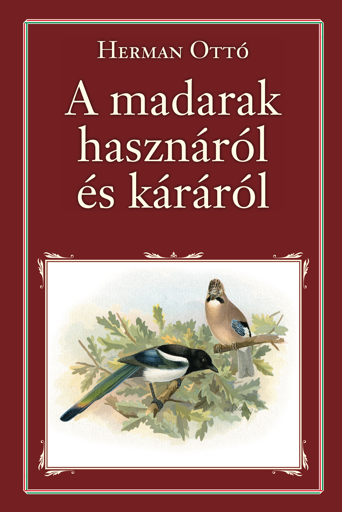
Ottó Herman: On the benefit and harm of birds
Bird legends
| "My children, let us love not with words, not even with tongue, but with action and in reality." |
| 1 John 3:18. |
| "We protect our birds not with mere words, nor with wailing, but with action!" |
| Otto Herman, 1911. |
I first heard about useful birds from my village grandmother. In the luscious fifties, the most useful bird for me was the goose thanks to my grandmother. He raised, herded, fed and stuffed some of his poultry, and so at Christmas we had goose legs for dinner and a huge foie gras was put on the festive table.
Pigeons and sparrows flew over the asphalt in Pest, sometimes blackbirds, on the bushy slopes of Gellért Hill, here and there songbirds wandered into the city in the parks... I knew the griffin from János the Valiant, I knew that Petőfi's favourite bird was the stork, our elderly relative had a caged finch, a parrot... I read in my storybook about King Matthias, whose coat of arms and shield it was decorated with a beautiful bird, a black raven, and maybe I heard the old Hungarian saying from someone: rare as the white raven... My godmother called my niece my little dove...
Many of us were, and many of us are, city children and adults who know very little about birds. At school, we learned that there are useful and harmful birds, but in zoos there are always more people standing and staring in front of the enclosures and cages of the big game than at the birds' flights.
The lion, the tiger is an exciting and mysterious predator, the crocodile is ugly and dangerous, the hippopotamus is pious, you can throw bread into its gaping mouth, you can try to look into the wolf's eyes with the caged wolf, the monkeys entertain the interested visitors with their gymnastic stunts and cheek cuts...
Birds are beautiful.
The reader is holding a hundred-year-old book in his hands. Ottó Herman has gone through four editions of his popular work in barely a decade, a guidebook for everyone: we can learn everything important about the birds living in our country from this picture book.
For hours, days - but certainly for a few moments - everyone delights in the birds, the splendor of their feathers, the enchanting music of their calls, and the happy gliding of their envied flight. ("...the birds are happy; maybe because they can fly" - sighed actor Zoltán Latinovits, remembering his childhood spent in the Capital Zoo.)
About the benefits and harms of birds - Herman Ottó wrote his wisely simple book for people who enjoy the singing and flight of birds, but who know little or nothing about birds, only misconceptions.
The raven is the coat of arms of the righteous King Matthias - surely it could be no other useful, legendary bird. Then, from Otto Herman's book, it turns out that the raven is actually a very harmful bird, "it destroys, robs nests, takes out eggs, baby birds and preys on carrion."
About the cuckoo, which everyone thinks is harmful - holding its eggs in its beak, it drops its eggs into the nests of other birds and hatches its chicks with other birds, which then grow rapidly and throw the other, weaker birds out of the nest - Herman Otto says just the opposite: "according to its diet, which consists of all kinds of insects, caterpillars, even the most hairy ones, the cuckoo the most useful bird”.
During grape ripening and harvest time, there is no more dangerous or harmful bird for farmers than a group of starlings flying in huge flocks like dark clouds and falling on bunches of grapes. The starling is a harmful bird during harvest. But throughout the year, it eats all harmful worms and bugs, attacks the grazing domestic animals, horses, cows, and sheep, and rids them of their tiny parasites. The starling's "year's work... brings a thousand times more benefit than the harm it can cause in the same amount of time."
There was a time when no one thought to ask the question: which bird is useful and which is harmful. The basic truth of the golden age: "Where mother nature is virginally pure and untouched, there are neither harmful nor useful birds, because they are only necessary."
Happy Golden Age! But even in the first decade of the 20th century, when Ottó Herman's book was born, almost nowhere in our country was pure and untouched nature. Today, perhaps nowhere in the world. Because where the human civilization that builds and destroys and destroys the balance of nature has not yet reached, there the acid rain created by it, harmful carbon dioxide concentration, radio activity that endangers everything, and ultraviolet radiation rushing down to Earth through the ozone hole irresponsibly enlarged by chemical vapors disturbs and destroys the ancient, untouched landscapes of our earth that can still be seen here and there.
Man could not and cannot conquer nature, only sometimes he transforms it cleverly, very often unwisely, irresponsibly, stupidly. Today, in our country of white ravens, the harmful black raven and cuckoo call are heard less and less by people walking through the woods and fields, and we can still often see starling clouds darkening the sky in autumn. Many of our birds, for example the crane (harmful), the osprey (beneficial), the goldfinch (rather useful), are dwindling and disappearing. Both useful and harmful birds fly around us: together with us, humans, they have also adapted to today's world, to our "civilized" environment.
The magpie (harmful) is now a foolishly hopping and squawking inhabitant of the big cities, the black thrush (useful) as well - a few years ago a pair nested in our kitchen window, in the thick of the lemon grass planted in the flower box -, the black crow (rather useful) walks around the side of the country road, not paying attention to the cars speeding by, the mallard, i.e. wild duck (harmful) Buda is enough in the middle, in the Feneketlen-to, he is happily frolicking with his ducklings, but a cometary heron (indifferent) has hardly been seen by today's people, even Herman Ottó, his succinct message: there is still...
We humans are partly useful and partly harmful. Very rarely: indifferent. In a good case: they are rather useful. Other times: they are more harmful. Or: they are harmful.
It is a human task - the unit of measure of our conscience - to decide how much of our actions is useful and how much is harmful. As in the case of starlings: we can be happy if only one-twelfth of our actions are harmful, useless, worthless. We humans decide about birds: harmful, useful, rather useful, indifferent.
Time is about us, people.
Ottó Herman helps you navigate the wonderfully diverse world of domestic birds. A smart study of his book can make the reader realize: it is worthwhile to face ourselves honestly and examine whether our actions and life are useful, harmful, rather useful, rather harmful...
This is not always easy to decide in the world of birds either.
But the birds are happy - maybe because they can fly.
Gábor Szigethy, October 3, 2012
Book reservation
[bookly-form staff_member_id=”1″]